BullyBlocker Research Team Highlights Cross-Platform Cyberbullying Research at ICWSM 2026
Members of the BullyBlocker research group presented two major studies showcasing advanced methodologies in network science and dynamic artificial intelligence to address cyberbullying across different digital spaces.

The Department of Computer Science is proud to highlight the impactful contributions of the BullyBlocker research team at the 20th International Conference on Web and Social Media (ICWSM 2026), held in Los Angeles, California, from May 26–29.
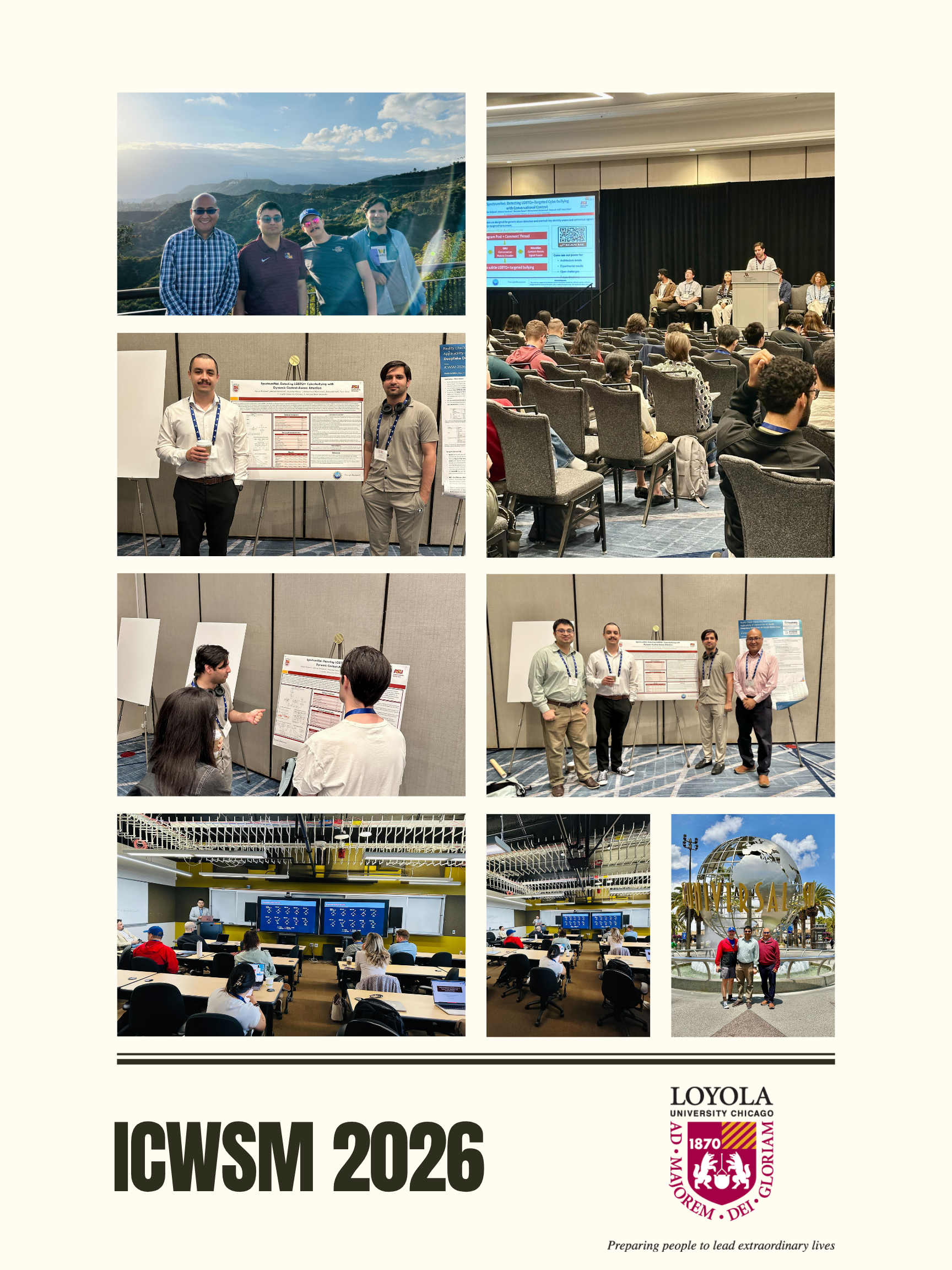
The BullyBlocker team, led by Dr. Yasin N. Silva, focuses on developing computational tools and models to understand, detect, and mitigate online harassment. Members of the research group presented two major studies showcasing advanced methodologies in network science and dynamic artificial intelligence to address cyberbullying across different digital spaces.
Analyzing Patterns of Harassment on Instagram
At the International Workshop on Cyber Social Threats (CySoc 2026), held in conjunction with the main conference, Professor Satyaki Sikdar presented the paper:
- "Network Analysis of Cyberbullying Interactions on Instagram"
- Authors: Satyaki Sikdar, M. Sandoval, T. Hales, C. Kilroy, M. Juarez, T. Rosario, J. Rosendo, D. Hall, and Y. Silva.
This study uses network analysis to understand the complex behavioral structures and interaction patterns underlying cyberbullying instances on Instagram.
Advancing Context-Aware Detection for Vulnerable Communities
At the main ICWSM conference, PhD student and Research Assistant Arslan Bisharat presented a framework designed to protect marginalized groups online:
- "SpectrumNet: Detecting LGBTQ+ Cyberbullying with Dynamic Context-Aware Attention"
- Authors: Arslan Bisharat, Manuel Sandoval, Mujtaba Nazari, Deborah L. Hall, Mohammed Abuhamad, and Yasin N. Silva.
The research introduces SpectrumNet, a cutting-edge model that utilizes dynamic attention mechanisms to understand the surrounding context of online conversations, significantly improving the accuracy of detecting nuanced and identity-based cyberbullying targeting the LGBTQ+ community.
The double appearance at ICWSM highlights the department’s ongoing leadership in social computing, data science, and AI for social good. Congratulations to the BullyBlocker team on their excellent representation of our department on the international stage!